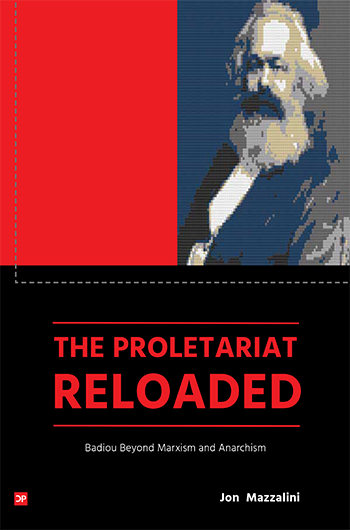
The Proletariat Reloaded: Badiou Beyond Marxism and Anarchism
Jon Mazzalini
B & W 229 x 152 mm | Perfect Bound on White w/Matte Laminate | 226 pages | Paperback ISBN 978-1-910761-13-7 | E-book (ePDF) ISBN 978-1-910761-14-4 | 2 November 2021


Jon Mazzalini
B & W 229 x 152 mm | Perfect Bound on White w/Matte Laminate | 226 pages | Paperback ISBN 978-1-910761-13-7 | E-book (ePDF) ISBN 978-1-910761-14-4 | 2 November 2021
The Proletariat Reloaded is available from Blackwell’s (UK) and major online bookshops internationally at a recommended retail price of 15.00 GBP.
COUNTERPRESS is committed to making high-quality academic books accessible to all, including those who do not have the means to pay. If purchasing this e-book (PDF) isn’t possible for you, we think it's fair enough to provide access via the button below. Please bear in mind that we rely on income from sales to sustain our work—and we trust our readers to use this option only as a last resort.
The idea of the proletariat has been in decline in political theory in the last few decades, but resurgent in practice for brief periods when events inspire collective political action. Against the relegation of the proletariat seen in post-Marxist and even some anarchist thought, Alain Badiou’s theory of the subject and event has helped to resurrect the proletariat, in theory at least. At the same time, through postanarchist theory we can see a number of points of convergence between Badiou’s thought and poststructuralist thought, ultimately leading us to a post-event theory which is an antidote to the schism between Marxian and anarchist approaches. It is an approach which seeks to dispense with the self-obsessive theorising which has seen contemporary political movements dilute their meaning, and instead focuses minds on the truth of contemporary events.
This book is an important and original attempt to overcome the opposition between Marxism and anarchism, a rift that opened up with the First International in the nineteenth century and has to this day never had a chance to heal. Today, we are simply overwhelmed by events. Yet radical political theory lacks an adequate way of responding to them. The wager of this book is that by bringing together Marxian and anarchist strands of thought — through Badiou’s category of the Event — we can once again meet the challenges of the present in a manner worthy of the name ‘radical politics.’
— Saul Newman, Professor of Politics, Goldsmiths, University of London.
Jon Mazzalini carefully reconstructs the development of Badiou’s thought and thus makes the mature Badiou — certainly one of the most influential living philosophers — wholly comprehensible. Still more importantly, Mazzalini offers a highly original reading of Badiou, contending that his work unwittingly shares much ground with postanarchism, and in particular with the writings of Saul Newman. This is a fascinating approach, which is of great interest both to those who are new to Badiou or postanarchism, and to those who are more familiar with either system of thought. Mazzalini convincingly and with great clarity places the whole of his own argument in the context of progressive struggles of the early twenty-first century, and thus makes this book of real relevance to lived political experiences.
— Nick Hewlett, Professor Emeritus, University of Warwick
Introduction
Chp 1 / Marx’s Non-Philosophy, ‘Impossible Communism’ and a Non-Essentialist Proletariat
Chp 2 / Postanarchism and Badiou’s Early Dialectical Materialism: From Sartrean to Post-Althusserianism to Ontological Anarchism
Chp 3 / Being and Event and Postanarchist Ontology: Inevitable Intervention Against Inevitable States
Chp 4 / No More Heroes: Badiou, the Proletariat, Communism and Permanent Revolution
Chp 5 / Ideology and Insurrection: ‘Saint Badiou,’ Postanarchism, and Servitude
Chp 6 / Post-Evental Politics: The Self-Pricing of the Proletariat
Chp 7 / Conclusion
Appoendix: Terminology
Bibliography
Notes
Jon Mazzalini is an independent writer living in east London. He has a PhD from the University of London.
Footnote/Endnote:
Jon Mazzalini, The Proletariat Reloaded: Badiou Beyond Marxism and Anarchism (Oxford: Counterpress, 2021).
Bibliography:
Mazzalini, Jon. The Proletariat Reloaded: Badiou Beyond Marxism and Anarchism. Oxford: Counterpress, 2021.
Christine Schwöbel-Patel and Robert Knox
Colour 229 x 152 mm | Perfect Bound on White w/Matte Laminate | 296 pages | Paperback ISBN 978-1-910761-17-5 | E-book (ePDF) ISBN 978-1-910761-18-2 | 8 January 2024
Aesthetics and Counter-Aesthetics of International Justice is available from Blackwell’s (UK) and other online bookshops internationally at a recommended retail price of 25.00 GBP.
COUNTERPRESS is committed to making high-quality academic books accessible to all, including those who do not have the means to pay. If purchasing this e-book (PDF) isn’t possible for you, we think it's fair enough to provide access via the button below. Please bear in mind that we rely on income from sales to sustain our work—and we trust our readers to use this option only as a last resort.
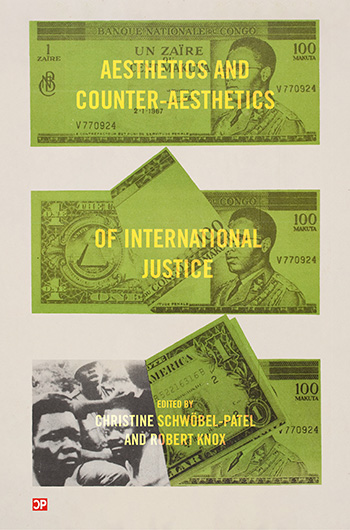
In recent years, growing attention has been paid to the relationship between international law and aesthetics. This collection situates this relationship within its wider political context, demonstrating that the question of aesthetics in not neutral but rather connected to the social, economic, and political relationships in which international justice is deeply embedded. The first part of the collection is an invitation to reflect on what we see and register in international justice, in particular in representations of those who suffer violence, including the violence of law. The second part of the collection uses different forms to reflect on how aesthetics can be turned against the dominant aesthetics and politics of international law, in the form of ‘counter-aesthetics’ through cartoons, interviews, parables, and a screenplay. This collection is the first of its kind to make visible the dominant and normalized aesthetics of violence and justice through a political economy lens; and to take seriously the limitations of the aesthetic forms that give violence and justice their expression.
PART I: AESTHETICS OF INTERNATIONAL JUSTICE
1. The Aesthetics of International Justice
Christine Schwöbel Patel and Robert Knox
Form: Academic chapter
2. The International Criminal Court in Focus: The Representation of Victimhood on YouTube
Sofia Stolk
Form:Screenplay
3. Displaying the Victim: Essentialized Aesthetics of Victimhood in Transitional Justice Debates
Padraig McAuliffe
Form: Academic chapter
4. The Image of the Asylum Seeker and Spectacular Deterrence in UK Asylum Law
Anne Neylon
Form: Academic chapter
5. Aesthetics and the Construction of the ‘Grateful Refugee’: Critical Perspectives from Law and Design
Christine Schwöbel-Patel and Deger Ozkaramanli
Form: Academic chapter
6. International Trials and Justice for Victims: A View from Practice
Wayne Jordash and Ruby Axelson
Form: Academic chapter
7. An International Justice Gown
Terry Duffy
Form: Artwork
PART II: COUNTER-AESTHETICS OF INTERNATIONAL JUSTICE
8. Counter-Aesthetics of International Justice
Christine Schwöbel-Patel and Robert Knox
Form: Academic chapter
9. Provocation and Possibility in Counter-Aesthetics
Anastasia Tataryn
Form: Academic chapter
10. Recasting Atrocities as Public Health Catastrophes
Randle DeFalco
Form: Academic chapter
11. Violence
Jo Frank
Form: Poem
12. Why Eichmann Couldn’t Laugh: Fifteen, One-Minute Parables
Gerry Simpson
Form: Parables
13.‘Poetic Justice Products’: International Justice, Victim Counter-Aesthetics, and the Spectre of the Show Trial
Alex Batesmith
Form: Academic chapter
14. Pinan: Comics and International Justice
Carolina Alonso Bejarano and Peter Quach
Form: Comic and Interview
15. Alternative Superheroes
Kate Evans
Form: Interview
Christine Schwöbel-Patel is Professor of Law at the University of Warwick, Alexander von Humboldt Fellow, and co-Director of the Centre for Critical Legal Studies.
Robert Knox is a Senior Lecturer in Law at the University of Liverpool, and an editor of ‘Historical Materialism: Research in Critical Marxist Theory’ and the ‘London Review of International Law’.
Footnote/Endnote:
Christine Schwöbel-Patel and Robert Knox, Aesthetics and Counter-Aesthetics of International Justice (Coventry: Counterpress, 2024).
Bibliography:
Schwöbel-Patel, Christine, and Knox, Robert. Aesthetics and Counter-Aesthetics of International Justice. Coventry: Counterpress, 2024.